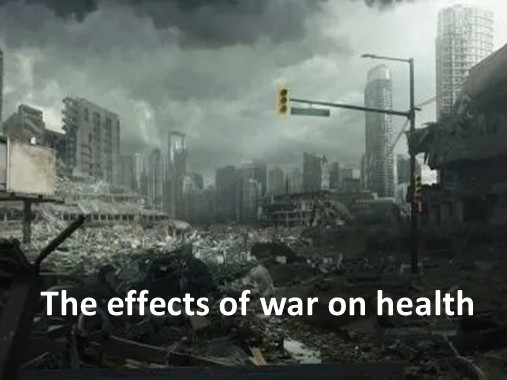
War kills in ways that extend far beyond the battlefield. The deaths caused by bombs, gunfire, and explosions are its most visible consequences, but they represent only part of its true health burden. War also kills by destroying hospitals, displacing health workers, interrupting medicines and vaccination programmes, contaminating water supplies, disrupting food systems, and making ordinary healthcare inaccessible. It transforms treatable diseases into fatal conditions and functioning health systems into systems of scarcity and survival.
For this reason, the health consequences of war cannot be measured simply by counting those directly killed or injured by violence. The true toll must also include the patient with kidney failure who can no longer access dialysis, the person with diabetes who cannot obtain insulin, the cancer patient whose treatment is interrupted, the pregnant woman unable to reach emergency obstetric care, and the child who dies from a preventable infection after vaccination and public-health programmes collapse. These deaths may never appear in battlefield statistics, but they are no less consequences of war.
Modern healthcare depends on a complex and interconnected infrastructure. Hospitals require electricity, clean water, oxygen, medicines, laboratories, communication networks, transportation, trained professionals, and functioning supply chains. Disrupting any one of these can compromise care; war can disrupt them all simultaneously. A hospital does not have to be reduced to rubble to cease functioning. Without electricity, water, fuel, medicines, blood products, or personnel, a standing hospital can become little more than an empty building.
The consequences rapidly extend beyond emergency and trauma care. Chronic diseases do not stop during war. Pregnancies continue. Children still require vaccination. Cancer progresses. People continue to experience myocardial infarctions, strokes, infections, renal failure, and surgical emergencies. Yet the capacity to respond to these conditions progressively disappears. What would ordinarily be preventable morbidity becomes disability; what would ordinarily be treatable disease becomes death.
Conflict also dismantles public health. Population displacement, overcrowding, unsafe water, inadequate sanitation, food insecurity, and disrupted vaccination and disease-surveillance programmes create conditions in which infectious diseases can spread rapidly. Malnutrition increases vulnerability to infection, particularly among children, while weakened laboratory and surveillance systems make outbreaks more difficult to detect and control.
Antimicrobial resistance adds another, less visible dimension. Conflict creates many of the conditions that facilitate the emergence and transmission of resistant organisms: overcrowded healthcare facilities, disrupted infection prevention and control, limited microbiological diagnostics, shortages of appropriate antimicrobials, and greater reliance on empirical treatment. At the same time, war weakens the surveillance and laboratory capacity needed to recognize and contain resistance. The consequences may cross borders and persist long after the conflict itself has ended.
The psychological damage is equally enduring. Exposure to violence, bereavement, displacement, uncertainty, deprivation, and the destruction of communities can leave profound mental health consequences. Children may lose not only family members and homes, but also education, stability, and the conditions required for healthy development. Health workers, expected to care for others while experiencing the same violence and loss, may face extraordinary psychological pressure. The scars of war are therefore carried not only in injured bodies but also in individuals, families, communities, and generations.
These harms are not distributed equally. War exploits and magnifies existing vulnerability. Children, older people, pregnant women, people with disabilities, those living with chronic diseases, and populations already affected by poverty or exclusion often have the fewest opportunities to escape or obtain alternative care. Where health systems were fragile before conflict, even limited disruption can have catastrophic consequences. War therefore does not merely create health inequalities; it deepens those that already exist.
Perhaps nothing illustrates this reality more clearly than attacks on healthcare itself.
A hospital is not simply a building. It is a concentration of society’s capacity to preserve life. An ambulance is not simply a vehicle. It is the link between a person in danger and the possibility of survival. Health workers are not interchangeable resources. Their knowledge and experience may require decades to build and cannot be rapidly replaced.
When healthcare is attacked, the victims are therefore not only those killed or injured in the immediate event. The consequences extend to every patient who subsequently cannot receive surgery, every woman who cannot access maternity care, every child who cannot be vaccinated, and every person with a chronic disease whose treatment is interrupted. One attack can produce a cascade of preventable suffering and death long after the explosion itself has ended.
Protecting healthcare during armed conflict is consequently not optional. It is a fundamental principle of international humanitarian law and an ethical obligation that must transcend political, military, national, and ideological divisions. Patients must be able to seek care without fear. Health workers must be able to treat the sick and wounded without intimidation or violence. Medical care must remain impartial and accessible according to need.
The international community must also resist becoming accustomed to attacks on healthcare. Repetition must not turn outrage into resignation. Every attack that is normalized weakens the principle that there must remain spaces in war where humanity is protected. Hospitals and health workers represent precisely such spaces.
Nor does the responsibility end when hostilities cease. Rebuilding health systems requires far more than reconstructing damaged hospitals. It requires restoring primary healthcare, vaccination, maternal and child health services, mental healthcare, rehabilitation, laboratories, disease surveillance, infection prevention and control, supply chains, and access to essential medicines. Above all, it requires rebuilding the health workforce and strengthening local institutions. International support should reinforce sustainable local capacity rather than create temporary parallel systems that disappear when external attention and funding move elsewhere.
Health-system resilience must also become an integral component of preparedness in countries at risk of conflict. Resilient supply chains, decentralized services, emergency stocks of essential medicines, protected health information, functioning referral networks, local production capacity, and trained community health workers can help preserve essential care when conventional systems are disrupted. Protecting health during war begins before the first hospital is damaged.
War should therefore be understood not only as a political, military, or humanitarian catastrophe, but as a profound public-health emergency. Its burden cannot be captured solely through battlefield mortality. It encompasses the direct and indirect deaths, disabilities, infections, mental health disorders, malnutrition, antimicrobial resistance, interrupted care, displacement, and health-system collapse that violence leaves behind.
And its effects do not end when weapons fall silent. A destroyed health system may take decades to rebuild. A displaced health workforce may never fully return. A child deprived of nutrition, healthcare, education, and security may carry those consequences throughout life. The health legacy of war can therefore outlive the conflict itself.
Healthcare is not simply another sector damaged by war. It is one of the foundations upon which societies survive and recover. When health systems collapse, preventable mortality rises, inequalities deepen, and communities become more vulnerable to disease, poverty, and instability. When healthcare is protected and rebuilt, it becomes an instrument of resilience, dignity, social cohesion, and ultimately peace.
In a world increasingly marked by conflict and instability, protecting healthcare is therefore more than a humanitarian responsibility. It is a defence of the principle that, even in war, human life retains its value.
Protecting healthcare from war is, ultimately, an obligation to protect life itself.
References
Sartelli M, Mossialos E, Coccolini F, Jammer I, Labricciosa FM, Barie P, Biffl WL, Memish ZA, Maeurer M, Kobinger GP, Ippolito G, Zumla A, Catena F; Global Consortium for Solidarity to Overcome Challenges, Restore Trustand Advance Science for a Sustainable Future. Global health at crossroads: uniting together to overcome challenges, restore trust and advance priorities for a sustainable future. World J Emerg Surg. 2025 Nov 10;20(1):84.
Sartelli M. Le guerre e la ricerca di un mondo più sicuro. Il ruolo della sanità [Wars and the search for a safer world. The role of healthcare.]. Recenti Prog Med. 2024 Sep;115(9):381-383.
Author
Massimo Sartelli
Leave a Reply